Why Is Cook Out So Cheap?
The real reasons behind its prices separating what Cook Out confirms, what reporting supports, and what’s reasonable inference, rather than presenting speculation as certainty.
Quick answer: Cook Out’s low prices appear to come from a combination of factors rather than one single trick: the company is privately owned and doesn’t use a traditional franchise model, many locations emphasize efficient drivethru and walkup service, and its Tray system is built to deliver a large amount of food for a low price. Cook Out also confirms that its meat is prepared fresh daily. Cook Out doesn’t publicly disclose a detailed pricing breakdown, so below we separate what the company confirms, what reporting supports, and what’s reasonable inference.
Cook Out is known for giving customers a lot of food for relatively little money. Its Tray combines a main item, two sides, and a drink, and regularly comes in well below what a comparable combo costs at most national chains though exact prices vary by location and change over time, so treat any specific dollar figure as a general reference rather than a current guarantee.
So how does Cook Out keep prices so low? There isn’t one secret ingredient or single cost cutting trick. The answer appears to be several parts of the business working together: company ownership rather than franchising, an efficient restaurant format, a value oriented Tray system, centralized fresh food operations, and a low profile marketing approach. Cook Out doesn’t publish a detailed cost breakdown proving exactly how much each factor saves, so this guide separates confirmed facts from reasonable analysis rather than presenting speculation as certainty.
| Factor | What It Means | Status |
|---|---|---|
| Company owned model | No traditional franchise royalty structure | Confirmed |
| Daily fresh food operations | Meat ground, delivered, and cooked fresh daily | Confirmed (official) |
| Efficient restaurant format | Drive thru and walkup emphasis at most locations | Well supported |
| Tray value system | Bundled main + 2 sides + drink, strong perceived value | Confirmed |
| Shared ingredient menu | Overlapping ingredients may simplify purchasing/prep | Reasonable inference |
| Low profile marketing | Growth via word of mouth over national ad campaigns | Well supported |
| Late night/college volume | High order volume at low margin per item | Reasonable inference |
Cook Out is privately owned and does not use a traditional franchise model every location is company operated rather than independently owned by a franchisee. That means the company isn’t collecting franchise fees or ongoing royalty payments the way many large chains do, since it isn’t licensing its brand out to independent operators in the first place.
That doesn’t prove that skipping franchise royalties translates into a specific dollar amount off any single menu item company ownership still comes with its own costs, including property, equipment, staffing, and everything else a restaurant business requires. What it does mean is that Cook Out’s cost structure removes one layer that many franchised competitors have to account for.
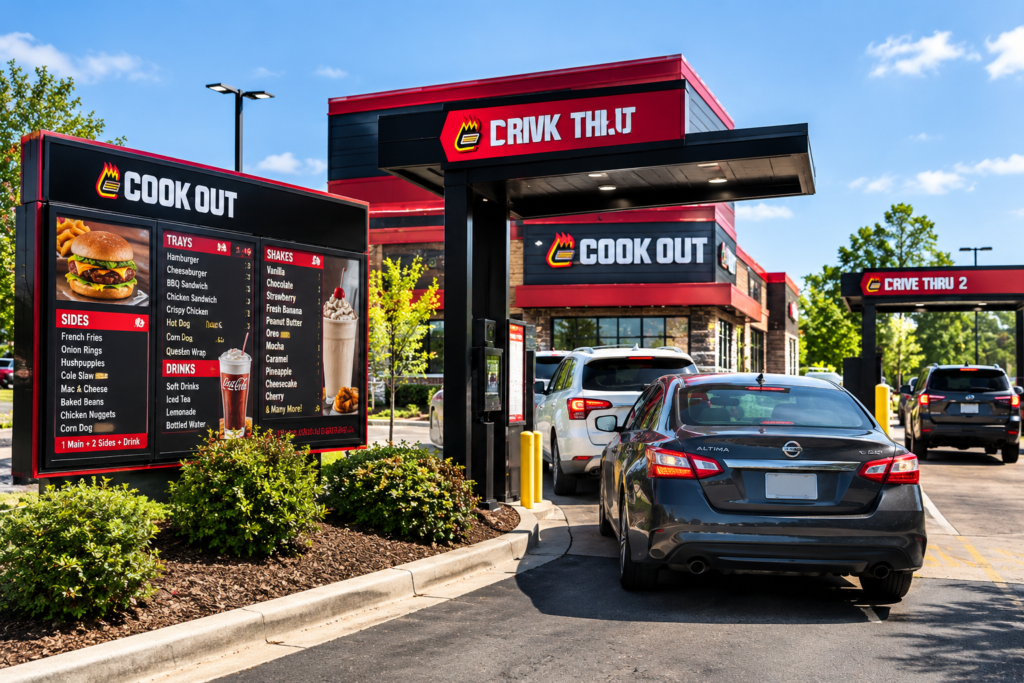
Many Cook Out locations emphasize drivethru and walkup ordering over a large traditional dining room. That said, Cook Out isn’t a drivethru only concept the company’s own history notes its first sitin location opening in 1996, and a dedicated sitdown restaurant format introduced later on. Seating availability varies by location, and the mix has evolved over the chain’s history.
Where locations do lean toward a compact, takeout oriented format, that design can reduce the amount of space and the staffing and maintenance that comes with it devoted to dinein seating. That’s a plausible contributor to lower overhead, though Cook Out hasn’t published figures quantifying exactly how much it saves.
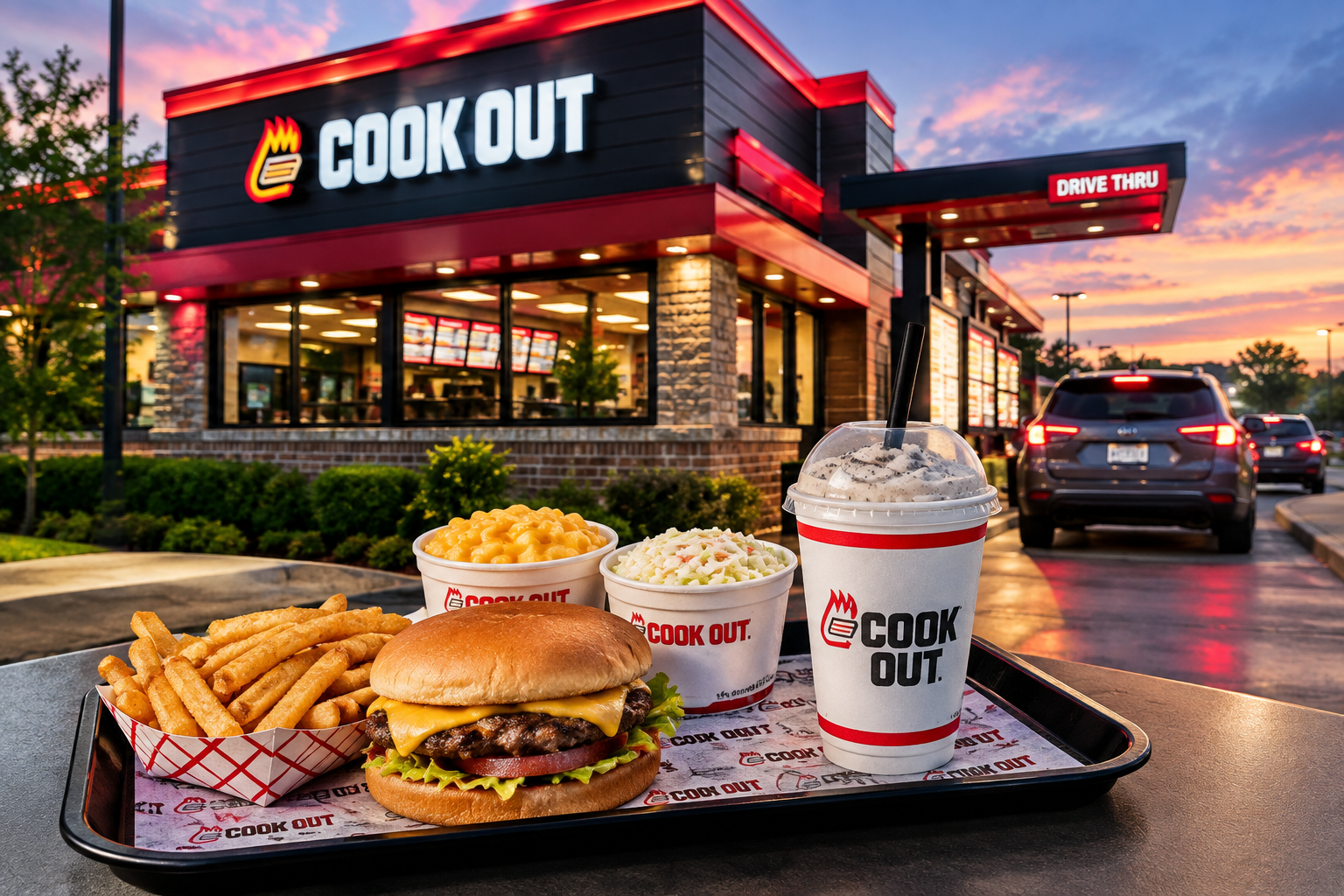
The Cook Out Tray is central to the chain’s value proposition: customers choose one main, two sides, and a drink from a wide selection, all bundled into a single combo. That structure makes the meal feel substantially larger than a conventional single item combo, even when the individual components are individually inexpensive. It’s one of the more concrete, verifiable reasons Cook Out feels like such strong value at the register you’re not comparing one burger to one burger, you’re comparing a full bundled meal to a smaller one.
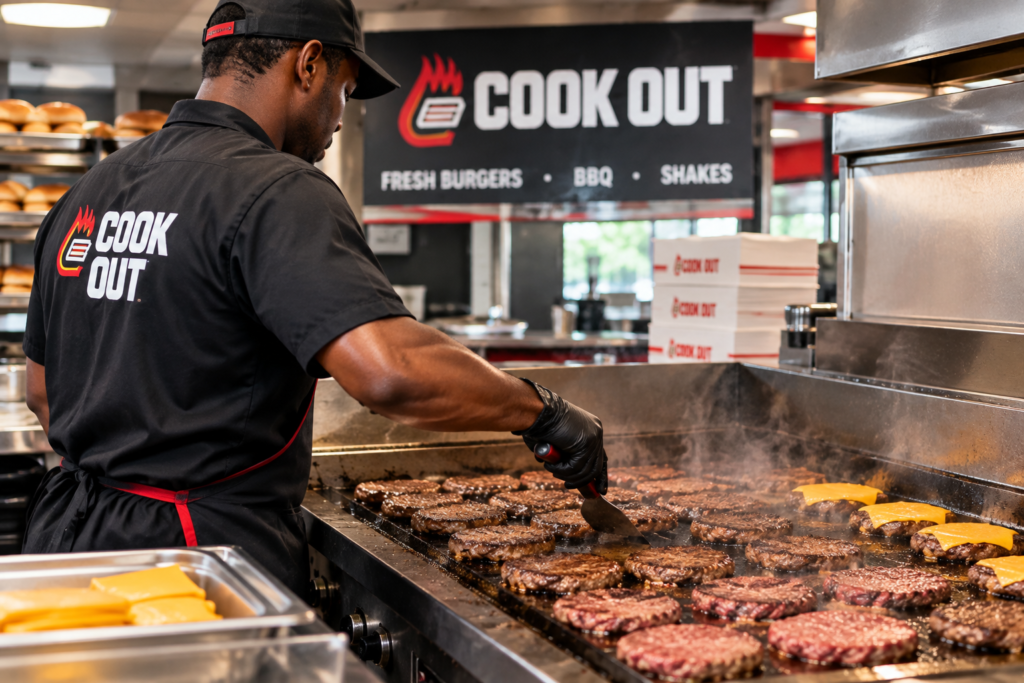
This is one of the strongest, most directly confirmed facts about Cook Out’s operating model. According to Cook Out’s own official company history, the chain established a meat commissary where meat is ground and formed into patties daily, loaded and delivered to each store daily, and cooked fresh each day the origin of the company’s “Always Fresh, Never Frozen” motto. A centralized daily preparation system like this can support consistent quality across many locations without relying on individually sourced or frozen inventory at each store, though Cook Out hasn’t published data quantifying the exact cost impact of this approach.
Cook Out’s menu is large burgers, hot dogs, BBQ, chicken, quesadillas, wraps, and dozens of milkshake flavors but many items draw from overlapping core ingredients: beef, chicken, bread, cheese, and a handful of common toppings recombined across the menu. That kind of design can simplify purchasing and kitchen prep compared with a menu built around highly specialized, item specific ingredients. This is a reasonable efficiency hypothesis based on the menu’s structure, not something Cook Out has confirmed as a stated strategy.
Cook Out has a much lower public marketing profile than national giants like McDonald’s or Wendy’s. Its growth has been closely associated with regional recognition and word of mouth rather than large scale national advertising, and the company’s leadership is notably private, rarely giving interviews about its operations. Because Cook Out doesn’t publicly disclose its marketing budget, it’s difficult to say precisely how much this contributes to its prices but a smaller ad spend is a plausible piece of the puzzle.
Many Cook Out locations operate late into the night, some until 3 or 4 AM, and a number cluster near college campuses. That positions the chain well to serve students and late night customers looking for inexpensive, filling food. It’s reasonable to view this as part of a volume oriented approach high order counts can support solid overall revenue even at a low margin per item though Cook Out hasn’t publicly stated that campus area or late night targeting is a formal, deliberate pricing strategy.
Not necessarily. A low menu price doesn’t automatically mean a restaurant uses lower quality ingredients. Cook Out’s own company history confirms its meat is ground, delivered, and cooked fresh daily rather than frozen, which directly supports its “Always Fresh, Never Frozen” positioning. That’s a stronger basis for the freshness claim than most independent fast food reviews can offer, since it comes from the company’s own documented history rather than marketing copy alone.
That said, confirming a fresh preparation process isn’t the same as guaranteeing every customer’s experience will be identical taste, consistency, and quality can still vary by item and by individual location, as with any restaurant chain. The more defensible conclusion is that Cook Out’s low prices can’t simply be explained away as the result of using frozen or inherently lower grade ingredients.
Low menu prices don’t necessarily mean thin profit margins. A restaurant chain can generate strong revenue by combining relatively low average prices with high order volume, efficient operations, and controlled costs the same logic behind other high volume, low price food concepts. Cook Out doesn’t publicly disclose enough financial detail to calculate its actual restaurant level margins, so any specific claim about how profitable the company is would be speculation. What can be said with more confidence is that the company has grown from one location in 1989 to several hundred restaurants across the Southeast, which is generally consistent with a sustainable business model rather than one operating at a loss.
Rather than compare specific dollar figures, which change frequently and vary by location, here’s how Cook Out’s meal structure generally differs from other fast food formats:
| Restaurant | Typical Meal Format | How It Differs |
|---|---|---|
| Cook Out | Tray: main + 2 sides + drink | Bundles more components into one combo than most competitors |
| McDonald’s | Burger + fries + drink | Single side, national franchise model |
| Wendy’s | Burger + side + drink | Single side, national franchise model |
| Five Guys | Burger + fries | Larger individual portions, generally higher price point |
| Shake Shack | Burger combo | Fast casual positioning, premium pricing |
Prices vary by location, chain, and time and change frequently check each restaurant’s current menu before using any figure as a purchasing reference.
Why is Cook Out so cheap?
A combination of factors: no franchise royalty structure since the company is privately owned and operates every location itself, an efficient restaurant format, a Tray system built around bundled value, confirmed daily fresh food operations, and a low profile marketing strategy.
Is Cook Out a franchise?
No. Cook Out is privately owned and does not use a traditional franchise model every location is company operated.
Does Cook Out use cheap or frozen ingredients to keep prices down?
No. Cook Out’s own company history confirms its meat is ground, delivered, and cooked fresh every day rather than frozen the basis of its “Always Fresh, Never Frozen” motto.
Why is the Cook Out Tray such good value?
The Tray bundles a main item, two sides, and a drink into one combo, which makes the meal feel substantially larger than a typical single item fast food combo.
Does Cook Out make money despite its low prices?
Likely yes, though the company doesn’t publicly disclose detailed financials. Low prices combined with high order volume and efficient operations can still produce solid overall revenue, and the chain’s growth from one location to several hundred is generally consistent with a sustainable business.
Does Cook Out have indoor seating, or is it drive thru only?
Both exist. Many locations emphasize drive thru and walk up service, but Cook Out has offered sit down seating at select locations since 1996, and seating availability varies by restaurant.
Why does Cook Out have so many locations near college towns?
This appears to be part of a volume oriented approach to reach customers who prioritize price and quantity, though Cook Out hasn’t publicly confirmed campus area targeting as a formal corporate strategy.
Cook Out does not publish a detailed breakdown of its pricing strategy or restaurant level financials, and its leadership rarely gives interviews. The explanations on this page combine facts confirmed directly by Cook Out’s own official company page, reporting on the chain’s operating model from outlets like Slate and Mashed, and clearly labeled analysis where the company hasn’t made a public statement. Where we’ve made an inference rather than stated a confirmed fact, we’ve tried to say so explicitly rather than present speculation as certainty.